ArcadópolisEspañol
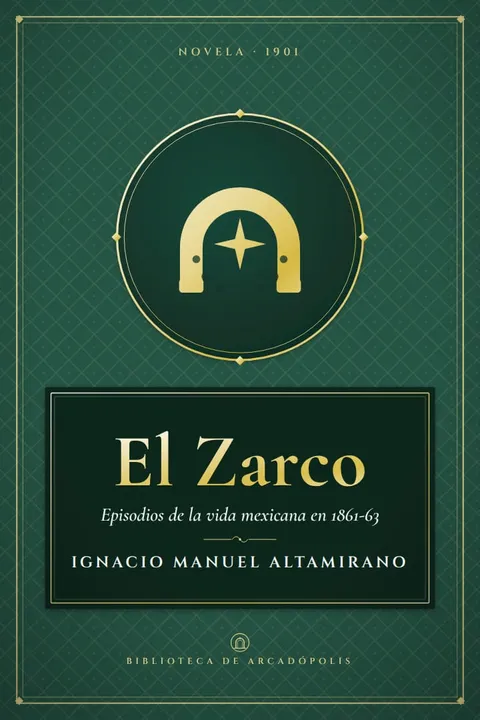
Cover of “El Zarco”

El Zarco by Ignacio Manuel Altamirano: read free online & download PDF or EPUB

Ignacio Manuel Altamirano (1834–1893)

El Zarco: Episodes of Mexican Life in 1861–63 is Ignacio Manuel Altamirano’s best-known novel, published in 1901, eight years after the author’s death. In Yautepec, while the bandits known as plateados terrorize Mexico’s hot lowlands, beautiful Manuela scorns Nicolás, an honest blacksmith, and runs away with El Zarco, a bandit chief covered in silver. Read the full novel free here, in the original Spanish, with no sign-up, or download it as a PDF or EPUB.

Free, no sign-up. A public-domain work.

What it is about

Yautepec is a village of orange and lemon groves in the tierra caliente, the hot lowlands south of the Valley of Mexico. In August 1861, as soon as the sun goes down, the villagers lock themselves in: the region is in the hands of the plateados, gangs of hundreds of horsemen decked out in silver on their clothes, hats and saddles, who rob, kidnap and kill from their hideout at Xochimancas, a ruined hacienda.

There lives Doña Antonia, a widow, with her daughter Manuela, fair, beautiful and proud; close by, with an aunt and uncle, lives her goddaughter Pilar, dark, gentle and melancholy. Nearly every afternoon they are visited by Nicolás, the Indigenous blacksmith of the Atlihuayan hacienda, an orphan from Tepoztlán who worked his way up to master smith. Doña Antonia wants him for a son-in-law; Manuela calls him an “indio horrible,” a hideous Indian; Pilar loves him in silence. What no one knows is that at night Manuela meets, at the garden wall, El Zarco, a blue-eyed bandit who gives her stolen jewels, and that in the case of a pair of earrings she finds two drops of fresh blood.

When Doña Antonia decides to leave for Mexico City with the troops due to pass through the village, Manuela agrees to elope with her lover. From then on the novel follows two paths: Manuela’s in Xochimancas, among bandits such as El Tigre, and that of Nicolás, who urges the troops to go and rescue her and clashes with a cowardly commander. Martín Sánchez Chagollán also appears, a rancher whose father and son are murdered by the plateados and who decides to hunt them down.

The ending (spoilers)

In Xochimancas Manuela discovers the squalor and cruelty of the bandits: she sees a French prisoner tortured to make him pay his ransom, and at a dance El Tigre tells her that at Alpuyeca El Zarco killed the wounded who had surrendered, and the women and children. She realizes that the man she loves is Nicolás, but it is too late. Doña Antonia falls ill with grief and dies; Nicolás, jailed for a few days for challenging the commander, discovers Pilar’s love and swears to marry her. Three months later he saves Martín Sánchez in a battle and wounds El Zarco, who is captured along with Manuela, although his comrades free them at Las Tetillas. Martín Sánchez obtains from President Juárez the power to hang bandits. On the day of Nicolás and Pilar’s wedding, the bridal party comes upon Martín’s troop beside the great amate tree, about to execute El Zarco and El Tigre, who had betrayed his own men. Manuela begs for mercy, clings to her lover and cries that she would rather die than see Pilar beside Nicolás wearing her crown of orange blossom. El Zarco is shot and hanged from the branch where the owl used to hoot; at the sight of him, Manuela falls dead.

Main characters

El Zarco
a blue-eyed plateado chief of about thirty, a former stable hand who hates everyone who has more than he does.
Manuela
Doña Antonia’s daughter, about twenty, beautiful, vain and in love with the bandit.
Nicolás
the Indigenous blacksmith of the Atlihuayan hacienda, honest, brave and proud of his work.
Pilar
Doña Antonia’s goddaughter, an orphan, dark-skinned and humble, secretly in love with Nicolás.
Doña Antonia
a widow, Manuela’s mother, who lives in terror of the bandits and longs to move to Mexico City.
Martín Sánchez Chagollán
a rancher from Ayacapixtla who becomes the plateados’ relentless pursuer; his men dress in black.
El Tigre
a mulatto bandit, El Zarco’s comrade and rival, who lusts after Manuela.
Salomé Plasencia
the chief leader of the bandits at Xochimancas.

Themes and context

Altamirano sets the novel just after the Reform War, as the French intervention was beginning, when the government, absorbed by the war, could not hold the bandits in check, and he insists that Martín Sánchez Chagollán is a “strictly historical figure, as are Salomé Plasencia and El Zarco.” He blends the Romanticism of an elopement on a stormy night and the omen of the hooting owl with a realistic portrait of the hot lowlands. Everything is built on contrasts: Manuela’s roses and Pilar’s orange blossom, stolen silver and honest work, the fair-haired white bandit and the Indigenous blacksmith.

It is still read because it raises questions that remain alive: what a community can do when the state fails to protect it, whether taking justice into one’s own hands is justice (of Martín Sánchez the narrator says: “An eye for an eye and a tooth for a tooth. Such was his penal code”) and why people are scorned for their colour or origins.

About the author

Ignacio Manuel Altamirano was born into an Indigenous family in Tixtla, in today’s state of Guerrero, on 13 November 1834, and died in Sanremo, Italy, on 13 February 1893. A liberal, he fought in the Ayutla Revolution, the Reform War and against the French intervention.

He was a teacher, a journalist and the founder of the magazine El Renacimiento; he championed free, secular and compulsory primary education and presided over the Supreme Court. His novel Clemencia (1869) is often considered the first modern Mexican novel.

Reading facts

First published
1901
Genre
Novel
Pages
119 in the letter-size PDF
Words
51,088
Reading time
≈ 3 h 40 min
Language
Spanish
Formats
Letter-size PDF (956 KB) and EPUB (223 KB)
License
Public domain

How it begins

Capítulo I

Yautepec es una población de tierra caliente, cuyo caserío se esconde en un bosque de verdura. De lejos, ora se llegue de Cuernavaca por el camino quebrado de las Tetillas, que serpentea en medio de dos colinas rocallosas cuya forma les ha dado nombre, ora descienda de la fría y empinada sierra de Tepoztlán, por el lado Norte, o que se descubra por el sendero llano que viene del valle de Amilpas por el Oriente, atravesando las ricas y hermosas haciendas de caña de Cocoyoc, Calderón, Casasano y San Carlos, siempre se contempla a Yautepec como un inmenso bosque por el que sobresalen apenas las torrecillas de su iglesia parroquial.

De cerca, Yautepec presenta un aspecto original y pintoresco. Es un pueblo mitad oriental y mitad americano. Oriental, porque los árboles que forman ese bosque de que hemos hablado son naranjos y limoneros, grandes, frondosos, cargados siempre de frutos y de azahares que embalsaman la atmósfera con sus aromas embriagadores. Naranjos y limoneros por donde quiera, con extraordinaria profusión. Diríase que allí estos árboles son el producto espontáneo de la tierra; tal es la exuberancia con que se dan, agrupándose, estorbándose, formando ásperas y sombrías bóvedas en las huertas grandes o pequeñas que cultivan todos los vecinos, y rozando con sus ramajes de un verde brillante y oscuro y cargados de pomas de oro los aleros de teja o de bálago de las casas. Mignon no extrañaría su patria, en Yautepec, donde los naranjos y limoneros florecen en todas las estaciones.

Keep reading in the Library

Common questions

What is El Zarco about?

It follows Manuela, a young woman from Yautepec who in 1861 scorns Nicolás, an Indigenous blacksmith, and runs off with El Zarco, leader of a gang of plateados. Alongside it runs Pilar’s quiet love for Nicolás and the villages’ struggle against the bandits.

How many pages is El Zarco?

This edition’s letter-size PDF has 119 pages; it is about 51,000 words, roughly 3 h 40 min of reading. It has twenty-five short chapters, in Spanish.

Can I download El Zarco as a free PDF?

Yes. Download it free here as a letter-size PDF, ready to print, or as an EPUB, with no sign-up.

Is El Zarco in the public domain?

Yes. It was published in 1901 and Altamirano died in 1893, more than a hundred years ago, so it can be freely read, printed and shared.

Is there an English translation here?

No. This is the original Spanish text; the Library only publishes translations whose translators also died more than a hundred years ago.

This edition

El Zarco, de Ignacio Manuel Altamirano (1834–1893), se publicó por primera vez en 1901. Es una obra de dominio público en todo el mundo: su autor murió hace más de cien años.

Texto basado en la transcripción de dominio público de Wikisource en español (https://es.wikisource.org/wiki/El_Zarco), revisada y recompuesta para esta edición. Se eliminaron las plantillas y la navegación de la página y todo lo ajeno a la obra.

Cubierta y diseño originales de la Biblioteca de Arcadópolis.

Text source: Wikisource

More novels in Spanish