ArcadópolisEspañol
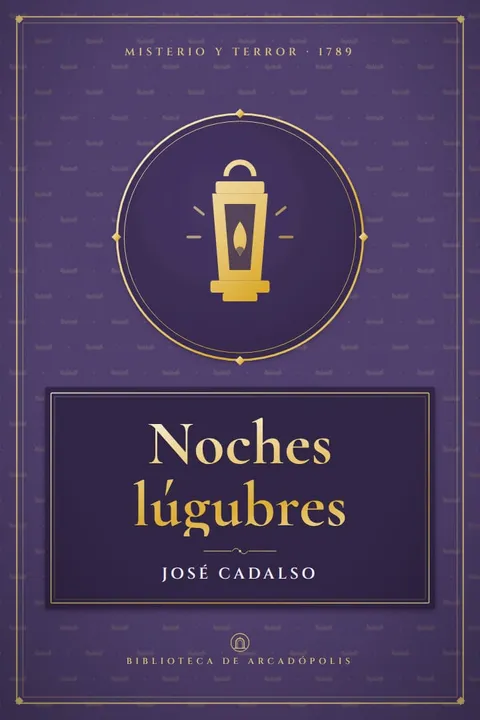
Cover of “Noches lúgubres”

Noches lúgubres by José Cadalso: read free online & download PDF or EPUB

José Cadalso (1741–1782)

Noches lúgubres (Mournful Nights) is the prose work in dialogue form that José Cadalso left unpublished at his death; it appeared in installments in 1789 and 1790. Over three nights of storm, prison and tombs, Tediato, driven to despair by the death of his beloved, pays a gravedigger to dig her up. Read it free here, in the original Spanish, with no sign-up, or download it as a PDF or EPUB.

Free, no sign-up. A public-domain work.

What it is about

It is a stormy night, and Tediato waits beside a church for the clock to strike two. He has paid Lorenzo, the church’s gravedigger, to help him with a task he will not explain. Lorenzo, who has buried the dead for thirty-five years without a tremor, goes in this time full of fear. Tediato tells him how one night, alone in that same church, he saw a shape with glowing eyes climb out of a pit: it was Lorenzo’s mastiff, which had fallen asleep in the grave.

As they lever up the slab, Lorenzo tries to guess whom they are looking for. Tediato’s father? His mother, a brother, a son, a friend? Each question unleashes a bitter speech against family and human friendship. Through the gap come the stench and the worms, and Tediato weeps over what has become of the body he loved; but his strength fails, the stone drops back and day breaks. Only then does he reveal his plan: to carry the corpse home, die beside it and set the house on fire so that both turn to ashes.

On the second night, while he waits again for Lorenzo, a stabbed man dies clutching his leg, and the law takes him for the murderer. Tediato spends the hours in a cell longing for death, while from the next cell he hears what seems to be a secret execution. When he is released, an hour before dawn, he stumbles over a child asleep in the street who turns out to be the gravedigger’s son, and he discovers the misery in which the family lives.

The ending (spoilers)

On the third night Tediato waits again on the street corner, going over the misfortunes of the two before. Lorenzo arrives, aged years in a few hours: his father and his wife have just died, his children are sick, his daughter has disappeared, and he wishes heaven would destroy him. Tediato, who feels himself a brother to every wretched soul, answers that “no one is unhappy who can make another happy,” and that more good depends on the gravedigger’s hands than on the splendor of all the kings. “Let us go, friend, let us go,” he says, and there the text ends: Cadalso left the third night unfinished, and we never learn whether they opened the tomb. Some later editions added an ending, and even a fourth night, that are not his.

Main characters

Tediato
a man in despair over the death of his beloved, who despises the world and longs to die.
Lorenzo
a poor gravedigger with many children, who agrees to help him for money.
The dead beloved
her name is never given; Tediato remembers her golden hair, her white hands and that she died in his arms.
Virtelio
Tediato’s friend, who tries in vain to make him eat and ends up leaving him alone.
The Magistrate
the officer of the law who, with his patrol, arrests Tediato for a crime he did not commit.
The child
Lorenzo’s eight-year-old son, whom Tediato finds asleep in the street.

Themes and context

Cadalso was a soldier and a writer of the Enlightenment, yet these pages are almost all feeling: night, storm, tombs, melancholy and the wish to die. That is why some critics see it as the work that opens Pre-Romanticism in Spanish literature. It is usually linked to the death of the actress María Ignacia Ibáñez, Cadalso’s beloved, in 1771; over the years a legend grew that he himself tried to dig her up, though scholars believe that happened only in his imagination. The name Lorenzo seems to come from the Night Thoughts of the English poet Edward Young.

Although it is prose, it moves like a poem, with parallel phrases, repetitions and exclamations: “¡Entre cuántos peligros camina el hombre el corto trecho que hay de la cuna al sepulcro!” (“Amid how many dangers man walks the short stretch from the cradle to the grave!”). In the nineteenth century it was hugely popular despite the censors and an Inquisition inquiry, opened after a complaint that accused it of inciting suicide and contempt for parents. It still shocks with its rawness, and its night-time church, its worms and its gravedigger make it ideal reading for Day of the Dead nights.

About the author

José Cadalso was born in Cádiz on 8 October 1741 and died on 26 February 1782 at the siege of Gibraltar, struck by a shell fragment, shortly after being promoted to colonel. He was a central figure in the Spanish literary life of his day.

He wrote the satire Los eruditos a la violeta (1772), the poems of Ocios de mi juventud and the Cartas marruecas (Moroccan Letters), which, like the Noches lúgubres, were published after his death. He is one of the leading authors of the Spanish Enlightenment.

Reading facts

First published
1789
Genre
Mystery & horror
Pages
21 in the letter-size PDF
Words
7,637
Reading time
≈ 33 min
Language
Spanish
Formats
Letter-size PDF (242 KB) and EPUB (83 KB)
License
Public domain

How it begins

Noche primera

TEDIATO y un SEPULTURERO

Diálogo

TEDIATO.- ¡Qué noche! La oscuridad, el silencio pavoroso, interrumpido por los lamentos que se oyen en la vecina cárcel, completan la tristeza de mi corazón. El cielo también se conjura contra mi quietud, si alguna me quedara. El nublado crece. La luz de esos relámpagos…, ¡qué horrorosa! Ya truena. Cada trueno es mayor que el que le antecede, y parece producir otro más cruel. El sueño, dulce intervalo en las fatigas de los hombres, se turba. El lecho conyugal, teatro de delicias; la cuna en que se cría la esperanza de las casas; la descansada cama de los ancianos venerables; todo se inunda en llanto…, todo tiembla. No hay hombre que no se crea mortal en este instante… ¡Ay, si fuese el último de mi vida, cuán grato sería para mí! ¡Cuán horrible ahora! ¡Cuán horrible! Más lo fue el día, el triste día que fue causa de la escena en que ahora me hallo.

Lorenzo no viene. ¿Vendrá, acaso? ¡Cobarde! ¿Le espantará este aparato que Naturaleza le ofrece? No ve lo interior de mi corazón… ¡Cuánto más se horrorizaría! ¿Si la esperanza del premio le traerá? Sin duda…, el dinero… ¡Ay, dinero, lo que puedes! Un pecho sólo se te ha resistido… Ya no existe… Ya tu dominio es absoluto… Ya no existe el solo pecho que se te ha resistido.

Las dos están al caer… Ésta es la hora de cita para Lorenzo… ¡Memoria! ¡Triste memoria! ¡Cruel memoria! Más tempestades formas en mi alma que nubes en el aire. También ésta es la hora en que yo solía pisar estas mismas calles en otros tiempos muy diferentes de éstos. ¡Cuán diferentes! Desde aquélla a éstos todo ha mudado en el mundo; todo, menos yo.
Keep reading in the Library

Common questions

What is Noches lúgubres about?

Over three nights, Tediato, a man in despair, tries to dig up the body of his beloved with the help of Lorenzo the gravedigger, while he reflects on death, grief and human cruelty.

How many pages is Noches lúgubres?

This edition’s letter-size PDF has 21 pages; it is about 8,000 words, roughly 33 min of reading. It is three nights in prose, in dialogue form, in Spanish.

Can I download Noches lúgubres as a free PDF?

Yes. Download it free here as a letter-size PDF, ready to print, or as an EPUB, with no sign-up.

Is Noches lúgubres in the public domain?

Yes. It was published in 1789 and 1790, and José Cadalso died in 1782, more than two hundred years ago, so it can be freely read, printed and shared.

Is Noches lúgubres finished?

Not quite. The third night was left unfinished in the manuscript and the first editions; some later editions added an ending, and even a fourth night, that are not by Cadalso. Here you read only the three nights he wrote.

This edition

Noches lúgubres, de José Cadalso (1741–1782), se publicó por primera vez en 1789. Es una obra de dominio público en todo el mundo: su autor murió hace más de cien años.

Texto basado en la transcripción de dominio público de Wikisource en español (https://es.wikisource.org/wiki/Noches_l%C3%BAgubres), revisada y recompuesta para esta edición. Se eliminaron las plantillas y la navegación de la página y todo lo ajeno a la obra.

Cubierta y diseño originales de la Biblioteca de Arcadópolis.

Text source: Wikisource

In these collections

More mystery and horror in Spanish