ArcadópolisEspañol
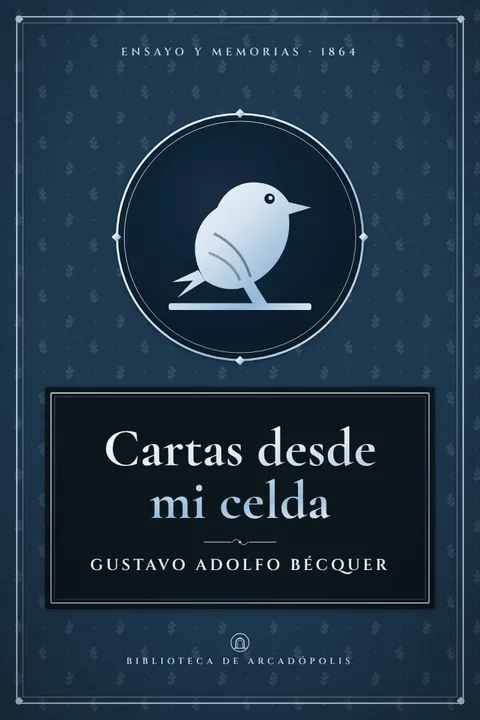
Cover of “Cartas desde mi celda”

Cartas desde mi celda by Gustavo Adolfo Bécquer: read free online & download PDF or EPUB

Gustavo Adolfo Bécquer (1836–1870)

Cartas desde mi celda (Letters from My Cell) are the nine letters Gustavo Adolfo Bécquer published in 1864 in the Madrid newspaper El Contemporáneo, written during his stay at the monastery of Veruela, at the foot of the Moncayo. They tell of the journey, of life among the ruins of the cloister, of the nearby villages and their legends of witches, castles and apparitions. Read them free here, in the original Spanish, with no sign-up, or download them as a PDF or EPUB.

Free, no sign-up. A public-domain work.

What it is about

At the end of 1863, ill, Bécquer settles with his brother, the painter Valeriano, in the Cistercian monastery of Veruela, abandoned by its monks since the confiscation of church lands. From his cell he writes to his colleagues at El Contemporáneo: “Queridos amigos” (“Dear friends”). He describes the journey by train to Tudela, by coach to Tarazona and by mule to the valley, and the kitchen where, by the fire, he reads Shakespeare and Byron while hoping to recover his health.

Every afternoon, at the foot of the Black Cross in the poplar avenue, he waits for the post rider who brings his newspaper, and feels the politics and bustle of the capital fade with the evening bell. In a village graveyard he thinks about death and recalls his boyhood dreams in Seville, when he wanted to be buried on the banks of the Guadalquivir; in another letter he proposes that painters, architects and writers travel the provinces to save the memory of a vanishing Spain, and in another he portrays the women of Añón, who carry firewood to Tarazona singing.

The most famous letters are about witches. A shepherd tells him how the village youths hunted down and killed Aunt Casca, whom they accused of witchcraft; the girl who serves him, oil lamp in hand, explains how to guard against spells; and Bécquer retells in his own way the legend of the castle of Trasmoz, raised in a single night by an old sorcerer, and that of Dorotea, the priest’s niece, from whom the local witches descend. The last letter, addressed to a young lady, tells of the apparition of the Virgin that gave rise to the monastery.

The letters

First letter
the journey from Madrid to Veruela by train, coach and mule, with his fellow travellers.
Second letter
waiting for the newspaper by the Black Cross, and the contrast between Madrid and the calm of the monastery.
Third letter
a village graveyard and the poet’s dreams of a resting place, from the banks of the Guadalquivir to a Gothic cloister.
Fourth letter
a plea to preserve the memory of the customs and monuments of old Spain.
Fifth letter
the market of Tarazona and the women of Añón, who live by selling firewood.
Sixth letter
a shepherd’s account of the death of Aunt Casca, the witch of Trasmoz.
Seventh letter
the legend of the castle of Trasmoz, raised in one night by a sorcerer.
Eighth letter
the story of Dorotea, niece of the priest Mosén Gil, and the line of the witches of Trasmoz.
Ninth letter
the legend of the Virgin of Veruela and the monastery’s abandoned church.

Themes and context

Bécquer spent the winter and part of the spring of 1864 at Veruela, and the letters appeared in El Contemporáneo between May and October under the general title Desde mi celda; they were collected in a book in 1871, after his death. This is post-Romantic prose: the melancholy of ruins, a love of the Middle Ages and of popular tradition, a fascination with the supernatural and, at the same time, the ironic eye of a journalist who knows the life of the capital well.

Many pages foreshadow his Leyendas (Legends), and the letters about the witches of Trasmoz are the most widely read. Today they are also read as a portrait of rural nineteenth-century Aragon and as the self-portrait of a poet who, at twenty-eight, already wrote: “Ser un comparsa en la inmensa comedia de la humanidad; y concluido mi papel de hacer bulto, meterme entre bastidores, sin que me silben ni me aplaudan” (“To be an extra in the vast comedy of mankind, and, my walk-on part done, to slip into the wings without being hissed or applauded”).

About the author

Gustavo Adolfo Bécquer was born in Seville on 17 February 1836 and died in Madrid on 22 December 1870, probably of tuberculosis. A poet, storyteller and journalist, he made his literary life in Madrid; his brother Valeriano, a painter, was with him at Veruela.

He won some fame in his lifetime, but his reputation came after his death, when his friends collected his writings. His Rimas (Rhymes) and Leyendas (Legends) together make one of the most popular books in Spanish literature.

Reading facts

First published
1864
Genre
Essays & memoirs
Pages
71 in the letter-size PDF
Words
35,742
Reading time
≈ 2 h 40 min
Language
Spanish
Formats
Letter-size PDF (661 KB) and EPUB (152 KB)
License
Public domain

How it begins

Carta primera

Monasterio de Veruela, 1864.

Queridos amigos: Heme aquí trasportado de la noche a la mañana a mi escondido valle de Veruela; heme aquí instalado de nuevo en el oscuro rincón del cual salí por un momento para tener el gusto de estrecharos la mano una vez más, fumar un cigarro juntos, charlar un poco y recordar las agradables, aunque inquietas horas de mi antigua vida. Cuando se deja una ciudad por otra, particularmente hoy, que todos los grandes centros de población se parecen, apenas se percibe el aislamiento en que nos encontramos, antojándosenos, al ver la identidad de los edificios, los trajes y las costumbres, que al volver la primera esquina vamos a hallar la casa a que concurríamos, las personas que estimábamos, las gentes a quienes teníamos costumbre de ver y hallar de continuo. En el fondo de este valle, cuya melancólica belleza impresiona profundamente, cuyo eterno silencio agrada y sobrecoge a la vez, diríase por el contrario, que los montes que lo cierran como un valladar inaccesible, me separan por completo del mundo. ¡Tan notable es el contraste de cuanto se ofrece a mis ojos; tan vagos y perdidos quedan al confundirse entre la multitud de nuevas ideas y sensaciones los recuerdos de las cosas más recientes!

Ayer, con vosotros en la Tribuna del Congreso, en la redacción, en el teatro Real, en la Iberia; hoy sonándome aún en el oído la última frase de una discusión ardiente, la última palabra de un artículo de fondo, el …

Keep reading in the Library

Common questions

What are the Cartas desde mi celda?

Nine prose letters Bécquer published in 1864 in El Contemporáneo, written during his stay at the monastery of Veruela, in Aragon. They mix travel writing, memories, reflections and legends of the Moncayo area.

How many pages is Cartas desde mi celda?

This edition’s letter-size PDF has 71 pages; it is about 36,000 words, roughly 2 h 40 min of reading. Each letter can be read in one sitting, in Spanish.

Can I download Cartas desde mi celda as a free PDF?

Yes. Download it free here as a letter-size PDF, ready to print, or as an EPUB, with no sign-up.

Is Cartas desde mi celda in the public domain?

Yes. It was published in 1864 and Gustavo Adolfo Bécquer died in 1870, more than a hundred years ago, so it can be freely read, printed and shared.

Is there an English translation here?

No. This is the original Spanish text; the Library only publishes translations whose translators also died more than a hundred years ago.

This edition

Cartas desde mi celda, de Gustavo Adolfo Bécquer (1836–1870), se publicó por primera vez en 1864. Es una obra de dominio público en todo el mundo: su autor murió hace más de cien años.

Texto basado en la transcripción de dominio público de Wikisource en español (https://es.wikisource.org/wiki/Cartas_desde_mi_celda), revisada y recompuesta para esta edición. Se eliminaron las plantillas y la navegación de la página y todo lo ajeno a la obra.

Cubierta y diseño originales de la Biblioteca de Arcadópolis.

Text source: Wikisource

In these collections

More essays and memoirs in Spanish