ArcadópolisEspañol
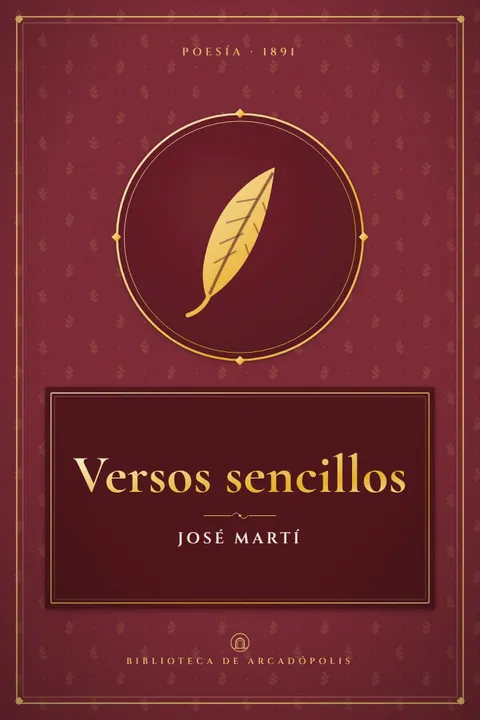
Cover of “Versos sencillos”

Versos sencillos by José Martí: read free online & download PDF or EPUB

José Martí (1853–1895)

Versos sencillos (Simple Verses) is the book of poems José Martí published in New York in 1891, the last he saw in print before his death. Its forty-six short poems, almost all in eight-syllable quatrains, speak of nature, love, friendship, death and Cuban freedom, and the lyrics of “Guantanamera” come from them. Read the full book free here, in the original Spanish, with no sign-up, or download it as a PDF or EPUB.

Free, no sign-up. A public-domain work.

What it is about

Martí wrote most of these verses in 1890 while convalescing in Haines Falls, a small town in the Catskill Mountains of New York. There are forty-six poems, numbered in Roman numerals and untitled. The first is a self-portrait: “Yo soy un hombre sincero / De donde crece la palma. / Y antes de morirme quiero / Echar mis versos del alma” (“I am an honest man from where the palm tree grows, and before I die I want to pour out the verses of my soul”). Then the poet tells what he knows and what he prefers: mountain air, the mountain stream, the poor of the earth, a true friend over love.

There are poems of love and disillusion, like those about Eva, fair-haired and “traitorous”, or the story of the girl from Guatemala who “died of love”. There are scenes, like a Spanish dancer on stage. And there are poems of homeland and war: a mother crossing gunfire to find her son (XXVII), a boy shot “by the king’s rifles” (XXIX), a slave ship unloading its captives and a child who swears to wash the crime away with his blood (XXX).

The book closes with a dream of marble heroes who wake and grip their swords (XLV) and a poem addressed to verse itself, “my loving companion”, with whom the poet will be saved or damned (XLVI).

Main poems

I. “Yo soy un hombre sincero”
the poet’s self-portrait; its opening lines supply the lyrics of “Guantanamera”.
IX. “La niña de Guatemala”
the burial of a girl who died of love when the man she waited for came back married.
XXIII. “Yo quiero salir del mundo”
the wish to die without hiding: “Yo soy bueno, y como bueno / Moriré de cara al Sol!” (“I am good, and like a good man I will die facing the sun!”).
XXX. “El rayo surca, sangriento”
a slave ship unloads its captives in a storm; at the foot of a hanged slave, a boy swears to put an end to that crime.
XXXIX. “Cultivo una rosa blanca”
the same white rose for the true friend and for the cruel one who tears out his heart.
XLIV. “Tiene el leopardo un abrigo”
in praise of friendship: “Tiene ala el ave: ¡yo tengo / Allá en México un amigo!” (“The bird has wings: I have a friend back in Mexico!”).

Themes and context

Martí published these verses in New York, where he lived in exile and organized the struggle for Cuban independence. He is considered the initiator of Spanish American modernismo, but here he chooses the opposite of ornament: popular forms, everyday words, clear rhyme. That simplicity holds love, mourning, friendship, nature and freedom: “¡La esclavitud de los hombres / Es la gran pena del mundo!” (“The slavery of men is the great sorrow of the world!”), says poem XXXIV.

Its lines live on in popular memory: the best-known lyrics of “Guantanamera”, adapted by Julián Orbón and carried around the world by Pete Seeger in the 1960s, come from its opening stanzas, and “Cultivo una rosa blanca” is learned by heart in schools across Latin America.

About the author

José Martí was born in Havana on 28 January 1853 and was killed in battle at Dos Ríos, in the former province of Oriente, on 19 May 1895, in the Cuban War of Independence he himself had organized. A poet, journalist and diplomat, he founded the Cuban Revolutionary Party and is known as the Apostle.

He lived in Spain, Mexico, Guatemala and Venezuela, and from 1880 in New York. He wrote Ismaelillo (1882), Versos libres, Versos sencillos, the novel Amistad funesta (1885) and the essay Nuestra América (1891).

Reading facts

First published
1891
Genre
Poetry
Pages
61 in the letter-size PDF
Words
4,004
Reading time
≈ 17 min
Language
Spanish
Formats
Letter-size PDF (236 KB) and EPUB (93 KB)
License
Public domain

How it begins

I

Yo soy un hombre sinceroDe donde crece la palma.Y antes de morirme quieroEchar mis versos del alma.

Yo vengo de todas partes,Y hacia todas partes voy:Arte soy entre las artes,En los montes, monte soy.

Yo sé los nombres extrañosDe las yerbas y las flores,Y de mortales engaños,Y de sublimes dolores.

Yo he visto en la noche oscuraLlover sobre mi cabezaLos rayos de lumbre puraDe la divina belleza.

Alas nacer vi en los hombrosDe las mujeres hermosas:Y salir de los escombros,Volando las mariposas.

He visto vivir a un hombreCon el puñal al costado,Sin decir jamás el nombreDe aquélla que lo ha matado.

Rápida como un reflejo,Dos veces vi el alma, dos:

Keep reading in the Library

Common questions

What is Versos sencillos about?

Forty-six short poems in which José Martí speaks of what he loves: nature, friendship, women, his dead and the freedom of Cuba. Each poem is a scene, a memory or a confession.

How many pages is Versos sencillos?

This edition’s letter-size PDF has 61 pages; it is about 4,000 words, roughly 17 min of reading. It includes all forty-six poems, in Spanish.

What does Versos sencillos have to do with “Guantanamera”?

The best-known lyrics of this Cuban song adapt stanzas from Versos sencillos, beginning with “Yo soy un hombre sincero”. The adaptation is credited to Julián Orbón, and Pete Seeger made it famous around the world.

Is Versos sencillos in the public domain?

Yes. It was published in 1891 and José Martí died in 1895, more than a hundred years ago, so it can be freely read, printed and shared. Download it free here as a PDF or EPUB, with no sign-up.

Is there an English translation here?

No. This is the original Spanish text; the Library only publishes translations whose translators also died more than a hundred years ago.

This edition

Versos sencillos, de José Martí (1853–1895), se publicó por primera vez en 1891. Es una obra de dominio público en todo el mundo: su autor murió hace más de cien años.

Texto basado en la transcripción de dominio público de Wikisource en español (https://es.wikisource.org/wiki/Versos_sencillos), revisada y recompuesta para esta edición. Se eliminaron las plantillas y la navegación de la página y todo lo ajeno a la obra.

Cubierta y diseño originales de la Biblioteca de Arcadópolis.

Text source: Wikisource

More poetry in Spanish