 Arcadópolis
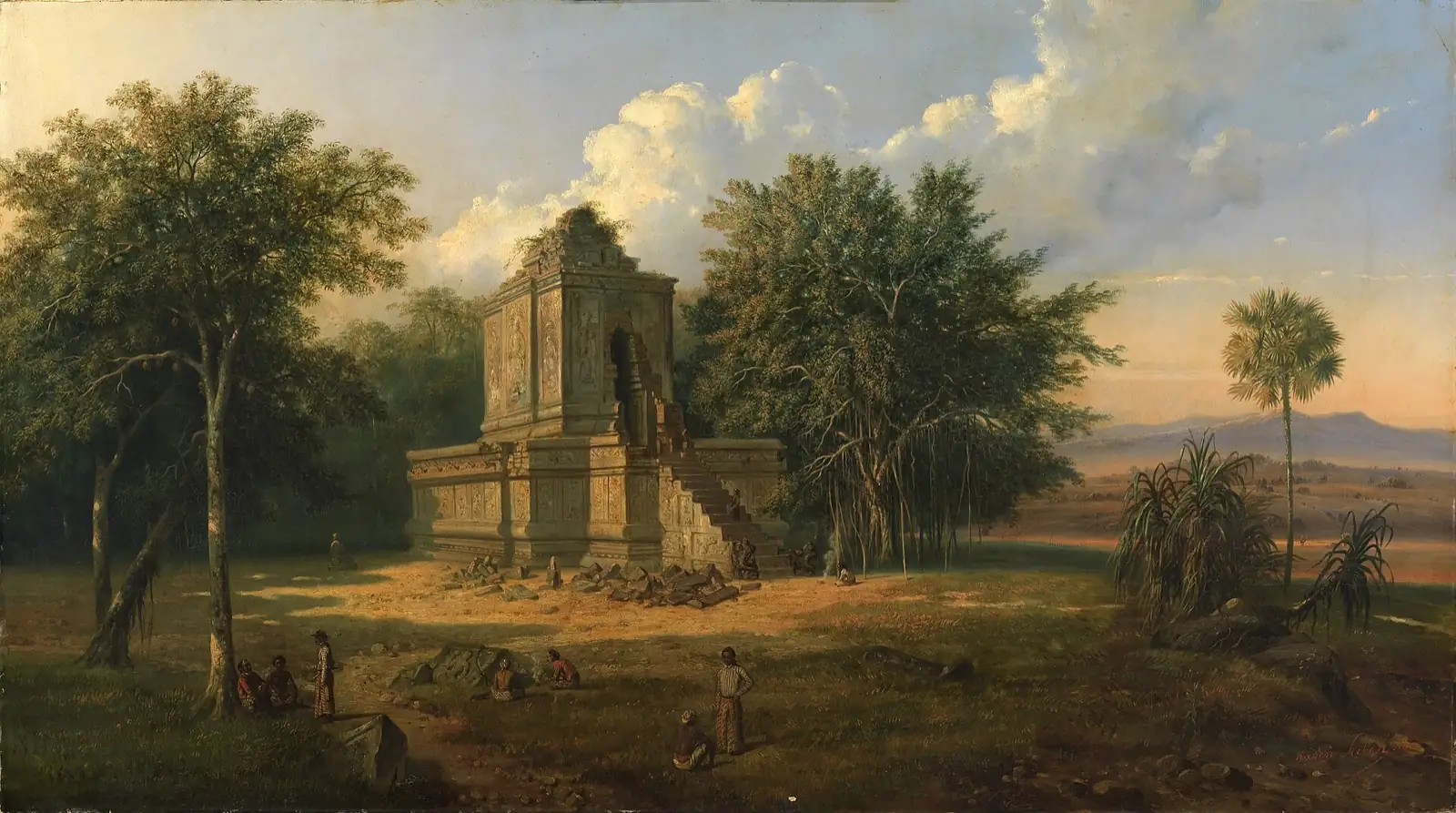
Javanese Temple in Ruins
What you see
A square stone temple rises in a clearing, just left of center. Its walls are covered in reliefs, a staircase on the right climbs to a dark doorway, and the top has crumbled, with plants growing between the stones. Two large trees flank it; the one on the right lets long roots hang down. Fallen blocks lie in front, and a few people sit or stand nearby.
Sunlight bathes the temple front and the ground around it in gold, while the foreground stays in shadow. Big white clouds pile up behind, and on the right the land opens onto a plain with low mountains. Look for the lone palm on the right and the small group seated at the foot of the tree on the left.
About Raden Saleh
Raden Saleh was born around 1811 near Semarang, on Java, and was the first Javanese to be trained as a painter in the Western manner: he arrived in Europe in 1829 and lived there for about twenty years. A Romantic painter, he became famous for his dramatic scenes of wild animals and hunts, his Javanese landscapes and his portraits. His painting “The Arrest of Prince Diponegoro” has been part of Indonesia’s national heritage since 2014, and his house in Jakarta, inspired by a German castle, is now a hospital.
More by Raden Saleh
 The Arrest of Prince Diponegoro
 Javanese Landscape, with Tigers Listening to the Sound of a Travelling Group
 Self-Portrait
 Forest and Native House
 Posthumous Portrait of Herman Willem Daendels, Governor-General of the Dutch East Indies
 Head of a Tiger
 Portrait of Johannes, Graaf van den Bosch, Governor-General of the Dutch East Indies
 Portrait of Mrs. W.J.S. van Alphen, Baroness van Reede van Oudtshoorn
 Two Tigers Creeping through the Grass
 Javanese Jungle
 Portrait of Jean Chrétien Baud, Governor-General ad interim of the Dutch East Indies
The Arcadópolis Museum has 443 public-domain works in 40 rooms, free to explore in 3D in your browser.