 Arcadópolis
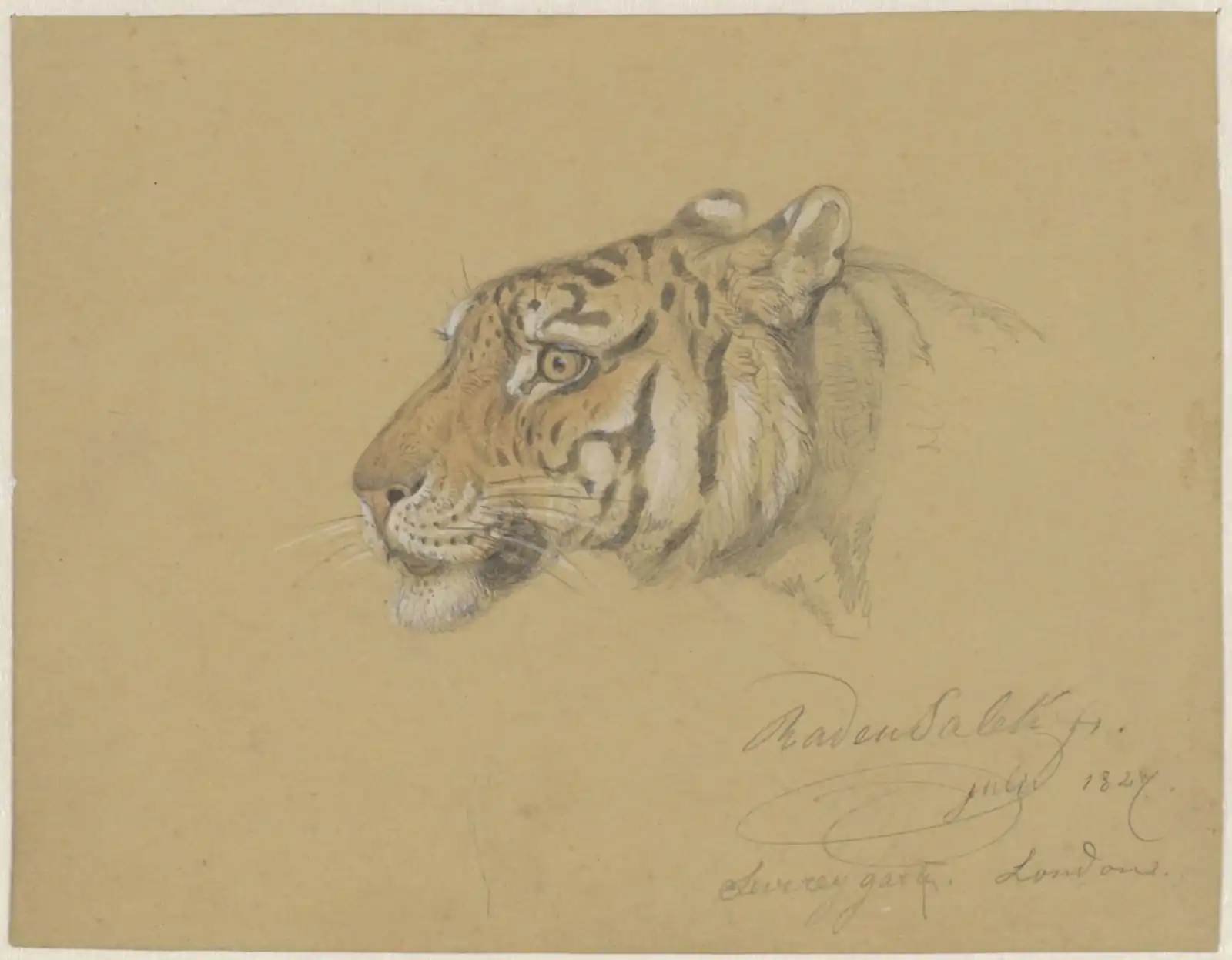
Head of a Tiger
Raden Saleh, 1847
What you see
A tiger’s head fills the left half of the sheet, seen in profile and facing left. The muzzle, the amber eye and the stripes are worked with care, while the neck and back are left as loose pencil lines that fade away to the right. The rest of the paper stays blank, so the eye settles on the tiger’s own eye.
Colour is kept to the face: ochres and oranges, black stripes and touches of white on the muzzle, above the eye and along the ears, standing out against the tone of the paper. The whiskers are hair-thin strokes. In the lower right, a handwritten inscription gathers the signature, the date and the word “London”.
About Raden Saleh
Raden Saleh was born around 1811 near Semarang, on Java, and was the first Javanese to be trained as a painter in the Western manner: he arrived in Europe in 1829 and lived there for about twenty years. A Romantic painter, he became famous for his dramatic scenes of wild animals and hunts, his Javanese landscapes and his portraits. His painting “The Arrest of Prince Diponegoro” has been part of Indonesia’s national heritage since 2014, and his house in Jakarta, inspired by a German castle, is now a hospital.
More by Raden Saleh
 The Arrest of Prince Diponegoro
 Javanese Landscape, with Tigers Listening to the Sound of a Travelling Group
 Self-Portrait
 Forest and Native House
 Posthumous Portrait of Herman Willem Daendels, Governor-General of the Dutch East Indies
 Javanese Temple in Ruins
 Portrait of Johannes, Graaf van den Bosch, Governor-General of the Dutch East Indies
 Portrait of Mrs. W.J.S. van Alphen, Baroness van Reede van Oudtshoorn
 Two Tigers Creeping through the Grass
 Javanese Jungle
 Portrait of Jean Chrétien Baud, Governor-General ad interim of the Dutch East Indies
The Arcadópolis Museum has 443 public-domain works in 40 rooms, free to explore in 3D in your browser.