 Arcadópolis
 Golden Ear
: free online ear training
Golden Ear is a free ear-training game, in your browser with nothing to download. You hear two notes, a chord or a phrase and pick what it is: the interval, the chord type or the instrument.
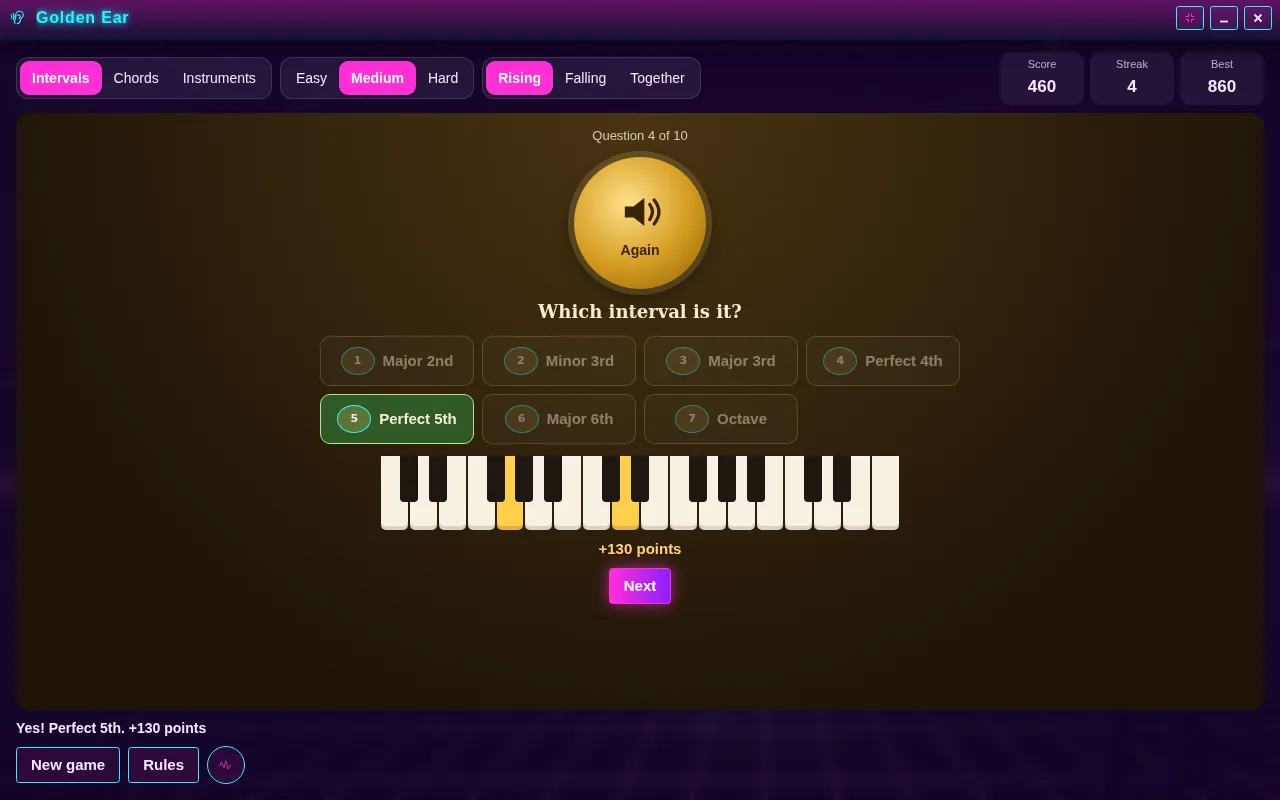
It has three modes and three levels. On Easy, four intervals (major second, major third, fifth and octave), two chords (major and minor) and four instruments; on Hard, all twelve intervals, eight chords and twelve instruments. You can hear each question as many times as you like, and when you answer you see the notes on a keyboard.
It’s one of the 51 games in the Arcadópolis Games folder.
Free, no ads, nothing to install.
Install Golden Ear on its own on your home screen
What it has
- Intervals: from the minor second to the octave, rising, falling or together.
- Chords: major, minor, diminished, augmented, dominant 7th, major 7th, minor 7th and suspended, as an arpeggio and then together.
- Instruments: twelve sounds from the Arcadópolis synth, from piano and organ to trumpet, bells and theremin.
- Three levels per mode and 10 questions per game.
- When you answer, the notes on the keyboard; if you got it wrong, you can hear your answer to compare.
- Records per mode and level, and six achievements.
How to play
- Open the Games folder and tap Golden Ear.
- Choose what to train (Intervals, Chords or Instruments) and the level.
- Tap the big button to listen and pick the answer (or use keys 1 to 9). Press Space to hear it again.
- Look at the notes on the keyboard and tap Next: the next question plays by itself.
How to recognize intervals
Each interval has its own character. The octave sounds like the same note higher up; the fifth, open and hollow; the fourth, like a call. The major third is bright and the minor third, wistful. Seconds sound like a scale, while the major seventh and minor second are tense, almost clashing. The tritone, right in the middle of the octave, is the most unstable of all. Start on Easy, with intervals that sound very different, and move up a level when you get 9 out of 10.
Why train your ear
Recognizing intervals and chords helps you play songs by ear, sing in tune, improvise and write down what you hear. Music schools call it ear training, and it improves with short, frequent practice: one 10-question game a day does more than an hour once in a while.
Common questions
Do I need to know music?
No. The names of the answers are right there and, when you answer, the keyboard shows which notes played. On Easy there are only a few, very different choices, so you learn by playing.
How many times can I hear each question?
As many as you like: the Again button (or the space bar) costs no points. If you get it wrong, you can also hear your answer to notice the difference.
Why do the instruments sound synthesized?
Because they come from the Arcadópolis synth, which imitates each instrument with oscillators. That way the game downloads no recordings and works offline; each sound keeps what sets it apart, like the harpsichord’s attack or the organ’s held note.
Also in Arcadópolis
 OctavesSlide the tiles and merge two equal notes to climb an octave, from C1 to C8, the highest key on the piano. With sound.
 Melody EchoA musical memory game with 19 public-domain melodies; also as an online duel.
 Singing GemsA match-3 game of singing crystals: each one is a note and the phrase at the top builds a melody. With specials and two modes.
Arcadópolis has 66 more apps on the same desktop: games, music, a 3D museum and a 3D library.