 Arcadópolis
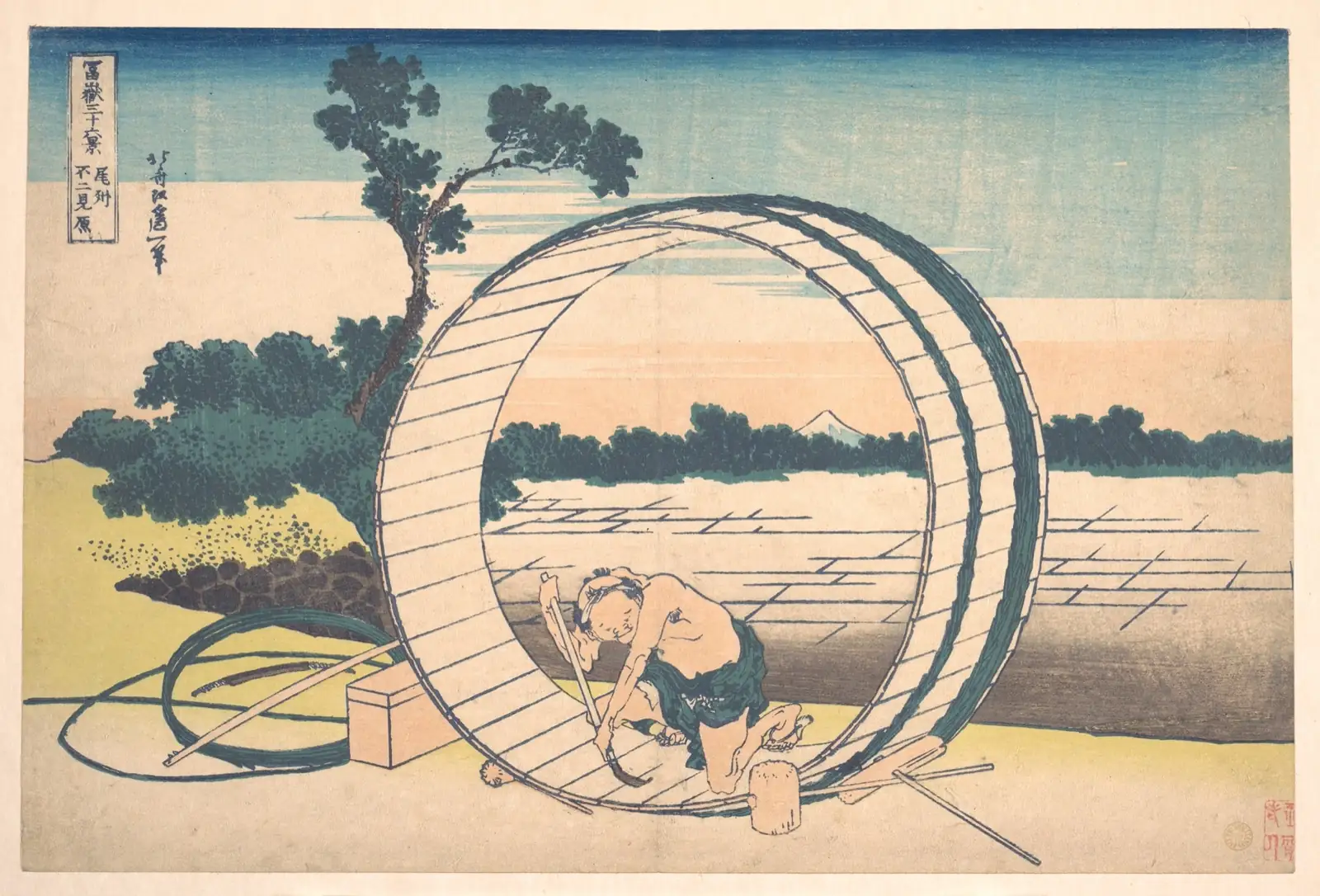
Fujimigahara in Owari Province
Katsushika Hokusai, c. 1830–1832
What you see
A huge barrel stands on edge, forming a circle across the center and right. Inside, a man with a bare torso and a cloth around his head bends over the wood with a tool. Through the ring appear a field crossed by lines, a band of trees and, on the horizon, a tiny white mountain. On the left, a tall, thin tree leans over some bushes.
The colors are few and clean: green, blue in the sky, pale yellow on the ground and the beige of the wood. The staves are marked with regular lines. Watch for the coiled hoops lying on the ground at left and the mallet and wooden box beside the cooper.
About Katsushika Hokusai
Katsushika Hokusai was born in Edo, today’s Tokyo, in 1760 and died there in 1849, after a long career as a painter, book illustrator and designer of woodblock prints. When he was about seventy he created “Thirty-six Views of Mount Fuji”, whose bright imported Prussian blue helped make landscape prints popular in Japan. Its most famous image, “The Great Wave”, became an icon of world art, and his daughter Katsushika Ōi, who worked by his side, was a remarkable painter too.
More by Katsushika Hokusai
 The Great Wave off Kanagawa
 South Wind, Clear Sky (Red Fuji)
 Storm below Mount Fuji
 Ejiri in Suruga Province
 Sazai Hall at the Temple of the Five Hundred Arhats
 Rōben Waterfall at Ōyama in Sagami Province
 Kintai Bridge in Suō Province
 Cranes on Branch of Snow-covered Pine
 Grasshopper and Iris
 Poem by Empress Jitō
 Chinese Boys Learning to Write and Paint
The Arcadópolis Museum has 443 public-domain works in 40 rooms, free to explore in 3D in your browser.