 Arcadópolis

The Departure of the Monção
What you see
A riverbank scene stretches from edge to edge. On the left, men haul chests and bundles and climb into crowded canoes; in the center, one in a red cap pulls on a rope. Farther out floats a roofed boat flying a red flag. On the right, under dark trees, a priest in white reads before the canoes, surrounded by women and children.
A hazy golden sky melts into the river, and hills with palm trees can just be made out in the distance. Shadows stretch across the sand in the foreground. Spot the man shoving a chest at lower left, the red bundle on the ground, and the raised arms in the canoes.
About José Ferraz de Almeida Júnior
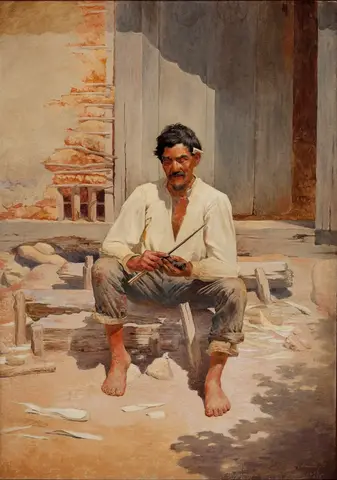
José Ferraz de Almeida Júnior was born in 1850 in Itu, in inland São Paulo, and studied at the Imperial Academy of Fine Arts in Rio de Janeiro and then, with a scholarship from Emperor Pedro II, at the École des Beaux-Arts in Paris, from 1876 to 1882. Back in Brazil he devoted himself more and more to the “caipira”, the country people of São Paulo, whom he painted in simple scenes of work and rest under the strong inland light. His “Caipira Cutting Tobacco” had so many imitators that Monteiro Lobato joked that future historians would think Brazilians of the time did nothing but cut tobacco. He died in Piracicaba in 1899.
More by José Ferraz de Almeida Júnior

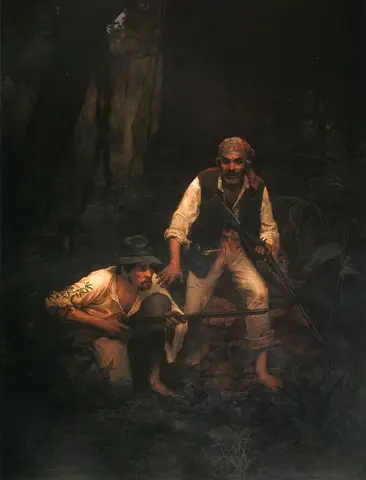

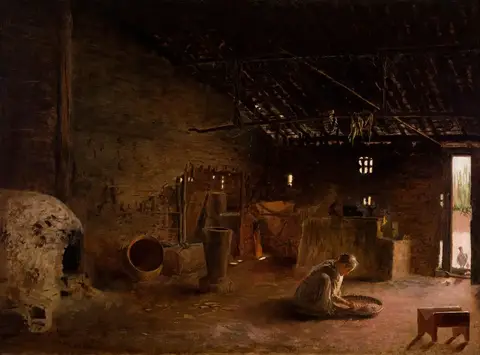
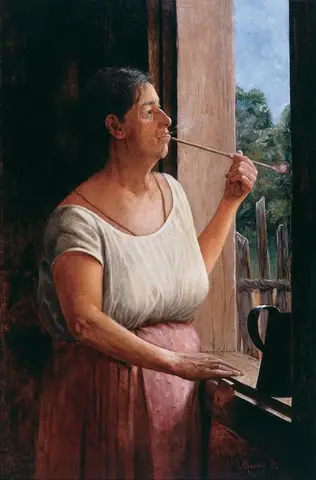
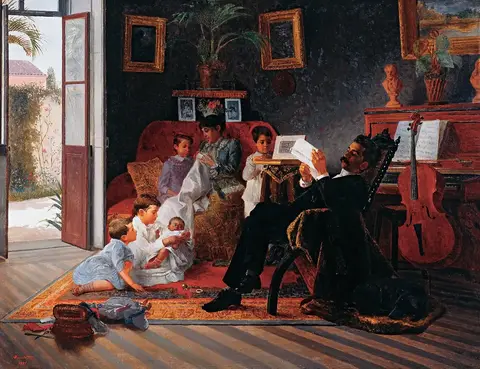
The Arcadópolis Museum has 443 public-domain works in 40 rooms, free to explore in 3D in your browser.