 Arcadópolis

Interrupted Whetting
What you see
The countryman leans forward with his feet in the water, gripping the handle of an axe that rests on a flat stone. He raises his other hand, palm out, in a gesture that says stop, and turns his head with wide-open eyes. Behind him, a great gray boulder and a dirt path lead up to a tile-roofed house ringed by a stick fence.
The light is strong and warm, tinting the earth, the shirt and the skin pink, and the water mirrors his legs. Spot the clay jug in the grass on the left, the hat lying on the rock, the long blade hanging at his back, and the notched planks on the right.
About José Ferraz de Almeida Júnior
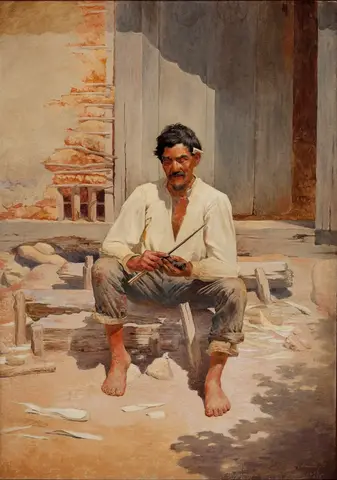
José Ferraz de Almeida Júnior was born in 1850 in Itu, in inland São Paulo, and studied at the Imperial Academy of Fine Arts in Rio de Janeiro and then, with a scholarship from Emperor Pedro II, at the École des Beaux-Arts in Paris, from 1876 to 1882. Back in Brazil he devoted himself more and more to the “caipira”, the country people of São Paulo, whom he painted in simple scenes of work and rest under the strong inland light. His “Caipira Cutting Tobacco” had so many imitators that Monteiro Lobato joked that future historians would think Brazilians of the time did nothing but cut tobacco. He died in Piracicaba in 1899.
More by José Ferraz de Almeida Júnior



The Arcadópolis Museum has 443 public-domain works in 40 rooms, free to explore in 3D in your browser.