 Arcadópolis

Narcissus
Caravaggio, c. 1597–1599
What you see
The picture splits into two nearly equal halves. Above, Narcissus kneels at the bank and leans toward the water, hands braced on the edge; below, his reflection repeats the figure upside down. His arms and their reflection form a closed ring, with his bare, brightly lit knee at its center. The eye drops from his face to the reflected one and climbs back up.
There is no landscape: dense darkness surrounds everything, and only the skin, the pale shirt and the leaf-patterned brocade catch the light. The reflection is darker and softer. Look at the hand on the left, whose fingertips graze the surface and leave a silvery line, and at the blue-green breeches beside the knee.
About Caravaggio
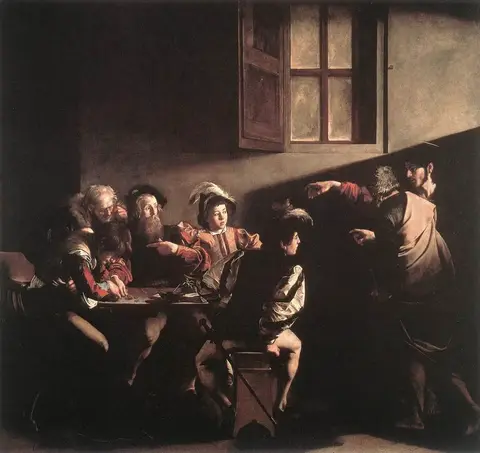
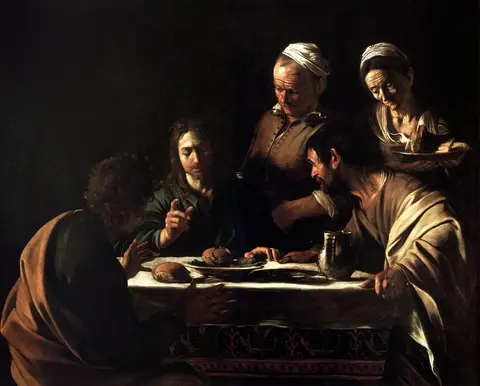
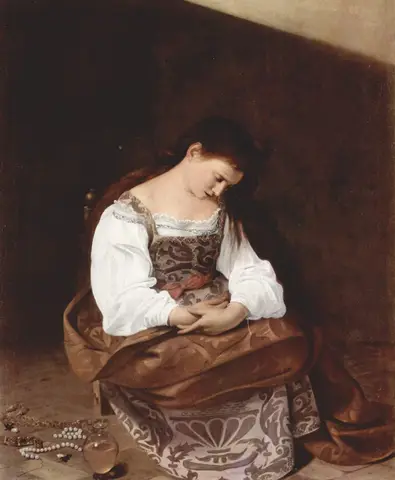
Michelangelo Merisi, called Caravaggio after his family’s home town, painted scenes as if they were happening on a dark stage lit by a spotlight. He used ordinary people from the street as models, which was very daring at the time. His use of light and shadow inspired painters all over Europe.
More by Caravaggio






The Arcadópolis Museum has 443 public-domain works in 40 rooms, free to explore in 3D in your browser.