ArcadópolisEspañol
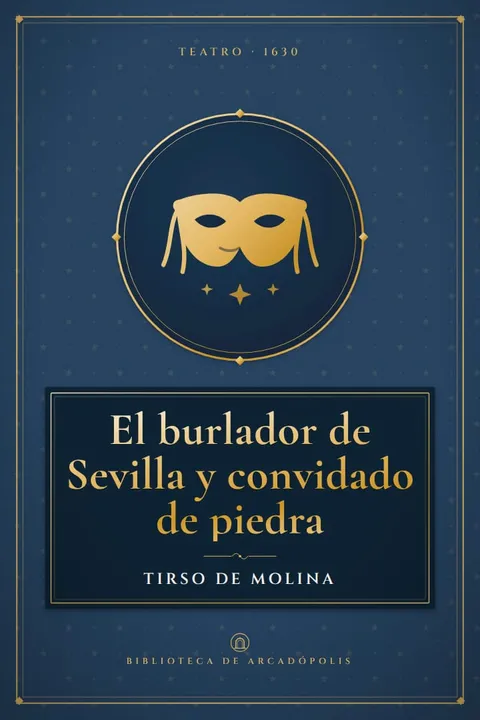
Cover of “El burlador de Sevilla y convidado de piedra”

El burlador de Sevilla y convidado de piedra by Tirso de Molina: read free online & download PDF or EPUB

Tirso de Molina (1579–1648)

El burlador de Sevilla y convidado de piedra (The Trickster of Seville and the Stone Guest) is the Golden Age play, published around 1630 and traditionally attributed to Tirso de Molina, that gave shape to the Don Juan legend. Don Juan Tenorio deceives one woman after another with promises of marriage and mocks a dead man, until the dead man’s statue accepts his invitation to supper. Read it free here, in the original Spanish, with no sign-up, or download it as a PDF or EPUB.

Free, no sign-up. A public-domain work.

What it is about

The play opens at night in the palace of the King of Naples. The Duchess Isabela discovers that the man with her is not her betrothed, Duke Octavio, but someone who has passed himself off as him: “Who am I? A man without a name.” It is Don Juan Tenorio, a young nobleman from Seville. His uncle, Don Pedro Tenorio, Spain’s ambassador, lets him escape over a balcony; the blame falls on Octavio, who flees to Spain.

Don Juan is shipwrecked on the coast of Tarragona. His servant Catalinón drags him out of the sea, and he is taken in by Tisbea, a fisher girl; that same night Don Juan seduces her with a promise of marriage and escapes on the two mares she had raised. Meanwhile, in Seville, King Alfonso XI plans to marry him to Doña Ana de Ulloa, daughter of the knight commander Don Gonzalo, unaware that Don Juan’s friend the Marquis de la Mota is in love with her.

Catalinón, Tisbea and even his own father warn him that everything is paid for at death, and again and again Don Juan answers: “¡Qué largo me lo fiáis!” (roughly, “That’s a long way off!”). His greatest pleasure, he says, is to deceive a woman and leave her dishonoured. Along the way lie a betrayed friend, a peasant wedding in Dos Hermanas and a tomb in a Seville church whose inscription calls for vengeance.

The ending (spoilers)

A letter from Doña Ana to Mota falls into Don Juan’s hands, and he keeps the appointment wearing the marquis’s cloak; Doña Ana discovers the trick, her father comes out with his sword and Don Juan kills him, and Mota, because of the cloak, is arrested for the crime. Then, on his way into exile in Lebrija, Don Juan seduces Aminta, the bride of Dos Hermanas, swearing that if he breaks his word may “a dead man” kill him. Back in Seville he mocks the statue on Don Gonzalo’s tomb and invites it to supper. The statue comes, and returns the invitation for the next day in its chapel. Don Juan keeps his word: when he gives the statue his hand, it burns him, denies him time to confess (“No hay lugar, ya acuerdas tarde”, “There is no time, you remember too late”) and the tomb sinks with both of them. Catalinón tells the king, it emerges that Doña Ana’s honour was never lost, and everyone marries: Octavio and Isabela, Mota and Doña Ana, Batricio and Aminta.

Main characters

Don Juan Tenorio
a young Sevillian noble, son of the king’s chamberlain, whose greatest pleasure is deceiving women.
Catalinón
his cowardly, comic servant, who reminds him of the reckoning.
Isabela
a duchess at the court of Naples, betrothed to Duke Octavio.
Duke Octavio
a Neapolitan noble in love with Isabela.
Tisbea
a fisher girl of Tarragona who boasted she had never loved anyone.
Don Gonzalo de Ulloa
knight commander of the Order of Calatrava, Doña Ana’s father.
The Marquis de la Mota
Don Juan’s friend and fellow carouser, in love with his cousin Doña Ana.
Aminta and Batricio
peasants of Dos Hermanas who marry on the day Don Juan arrives.
Don Diego Tenorio
Don Juan’s father, who tries in vain to reform him.

Themes and context

It is a Spanish Baroque comedia, written in verse in three acts and set in the fourteenth century, in the reign of Alfonso XI, across Naples, Tarragona, Seville and Dos Hermanas. Its subject is deceit and its punishment: Don Juan believes there will always be time to repent before he dies, and the play answers him through the statue: “Ésta es justicia de Dios, quien tal hace, que tal pague” (“This is God’s justice: as you do, so shall you pay”).

Its authorship is disputed. It was published around 1630 under Tirso de Molina’s name, but a related version, Tan largo me lo fiáis, was staged in Córdoba in 1617; some scholars attribute the play to Andrés de Claramonte, while others still regard it as Tirso’s. Whoever wrote it, it is the earliest fully developed stage version of the legend, later taken up by Molière’s Don Juan, Mozart’s Don Giovanni and Zorrilla’s Don Juan Tenorio.

About the author

Tirso de Molina is the pen name of Fray Gabriel Téllez, born in Madrid in 1579 (some sources say 1583), who died in Almazán, in today’s province of Soria, in 1648. A friar of the Order of Mercy, he lived in Santo Domingo from 1616 to 1618 and was a disciple of Lope de Vega.

In 1634 he claimed to have written some four hundred plays, among them Don Gil de las calzas verdes and El vergonzoso en palacio, and published five volumes of his drama.

Reading facts

First published
1630
Genre
Theatre
Pages
141 in the letter-size PDF
Words
14,413
Reading time
≈ 1 h
Language
Spanish
Formats
Letter-size PDF (523 KB) and EPUB (113 KB)
License
Public domain

How it begins

Acto I

[En Nápoles en el palacio real]

Salen don Juan Tenorio e Isabela, duquesa

Isabela

Duque Octavio, por aquípodrás salir más seguro.

Juan

Duquesa, de nuevo os jurode cumplir el dulce sí.

Isabela

¿Mi gloria, serán verdadespromesas y ofrecimientos,regalos y cumplimientos,voluntades y amistades?

Juan

Sí, mi bien.

Isabela

Quiero sacaruna luz.

Juan

¿Pues, para qué?

Isabela

Para que el alma dé fedel bien que llego a gozar.

Juan

Mataréte la luz yo.

Isabela

¡Ah, cielo! Quién eres, hombre?

Juan

¿Quién soy? Un hombre sin nombre.

Isabela

¿Que no eres el duque?

Juan

No.

Isabela

¡Ah de palacio!

Juan

Detente.Dame, duquesa, la mano.

Isabela

No me detengas, villano.¡Ah del rey! ¡Soldados, gente!

Keep reading in the Library

Common questions

What is The Trickster of Seville about?

Don Juan Tenorio, a Sevillian nobleman, deceives several women with promises of marriage and mocks a dead man’s statue by inviting it to supper. The statue comes.

Who wrote The Trickster of Seville?

It is traditionally attributed to Tirso de Molina, under whose name it was published around 1630, but some scholars attribute it to Andrés de Claramonte.

How many pages is The Trickster of Seville?

This edition’s letter-size PDF has 141 pages; it is about 14,000 words, roughly 1 h of reading. It is a verse play in three acts, in Spanish.

Is The Trickster of Seville in the public domain?

Yes. It was published around 1630; Tirso de Molina died in 1648 and its other possible author, Andrés de Claramonte, in 1626, nearly four centuries ago, so it can be freely read, printed and shared. Download it free here as a PDF or EPUB.

Is there an English translation here?

No. This is the original Spanish text; the Library only publishes translations whose translators also died more than a hundred years ago.

This edition

El burlador de Sevilla y convidado de piedra, de Tirso de Molina (1579–1648), se publicó por primera vez en 1630. Es una obra de dominio público en todo el mundo: su autor murió hace más de cien años.

Texto basado en la transcripción de dominio público de Wikisource en español (https://es.wikisource.org/wiki/El_burlador_de_Sevilla), revisada y recompuesta para esta edición. Se eliminaron las plantillas y la navegación de la página y todo lo ajeno a la obra.

Cubierta y diseño originales de la Biblioteca de Arcadópolis.

Text source: Wikisource

In these collections

More plays in Spanish