 Arcadópolis
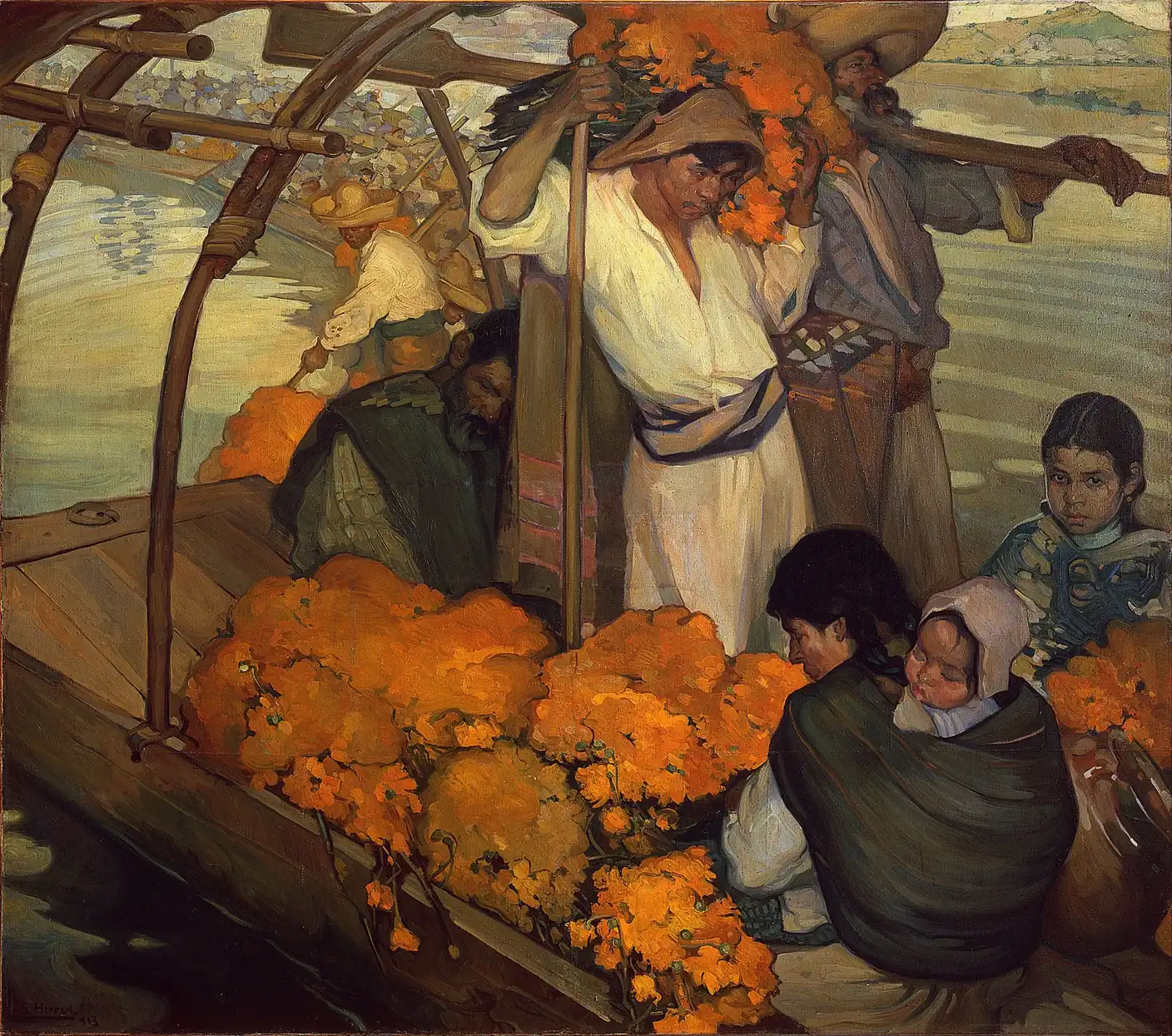
The Offering
Saturnino Herrán, 1913
What you see
A canoe fitted with wooden hoops glides diagonally along a canal, loaded with marigolds. At the center, a young man in white stands holding a bunch of flowers over his head; behind him, an old man in a hat pushes the boat along with a pole. At lower right, a woman seen from behind carries a sleeping baby, while a girl gazes straight at us.
The orange of the flowers fills the lower half and glows among the whites, muted greens and browns of the clothing. Herrán defines forms with firm outlines and nearly flat areas of color, and renders the water in pale horizontal strokes. In the background on the left, look for another canoe crowded with people.
About Saturnino Herrán
Saturnino Herrán was born in Aguascalientes in 1887 and trained at the Academy of San Carlos in Mexico City, studying drawing with the Catalan painter Antonio Fabrés and colour with Germán Gedovius. He turned scenes of everyday Mexican life into symbolic images of identity, and his painting “The Offering” (1913) is a classic example of Mexican modernism. He died in 1918, aged only 31, while working on “Our Gods”, a triptych commissioned for the Palace of Fine Arts, and his work became a model for the muralists of the following decades.
More by Saturnino Herrán






The Arcadópolis Museum has 443 public-domain works in 40 rooms, free to explore in 3D in your browser.