 Arcadópolis
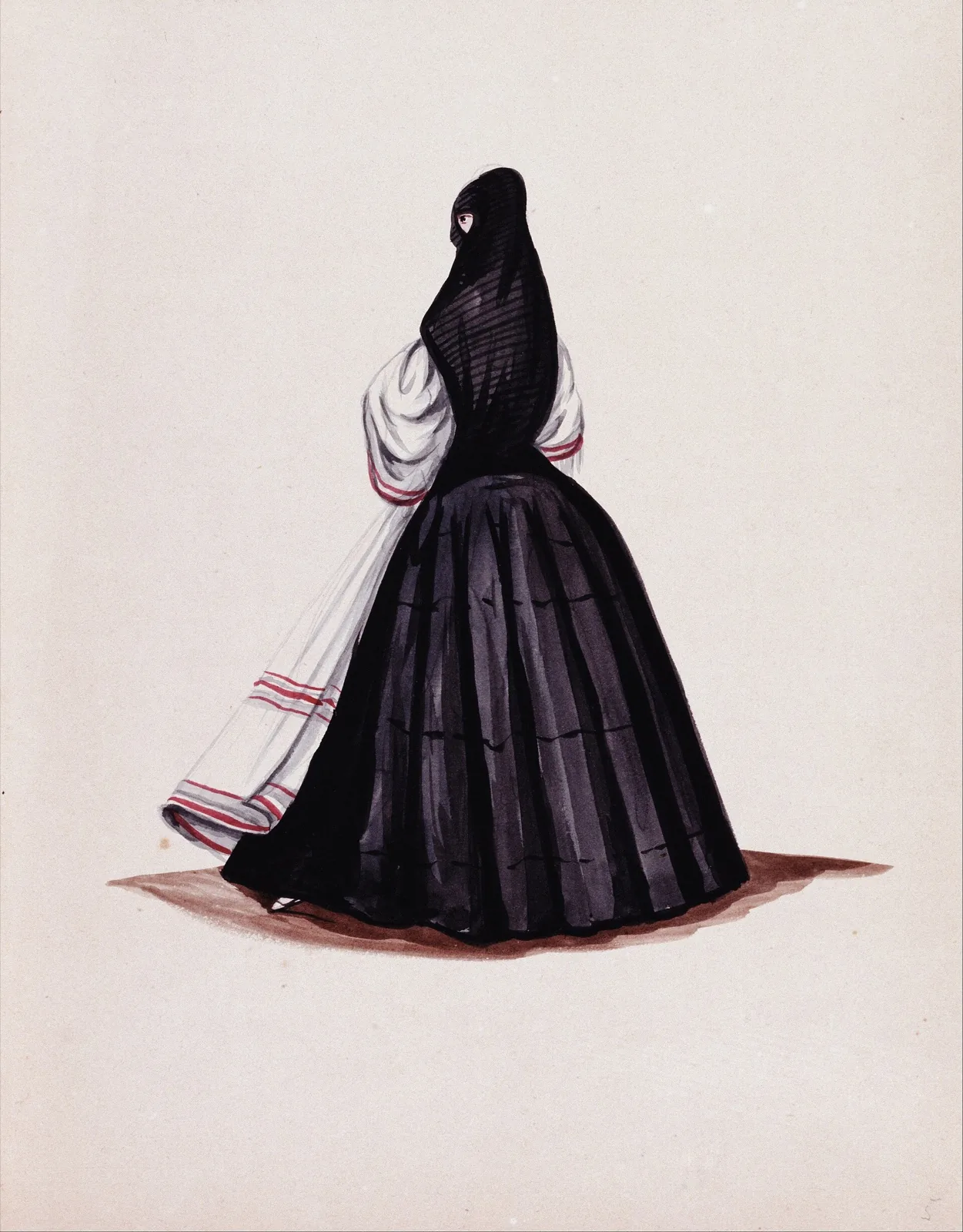
Tapada limeña
Pancho Fierro, c. 1840
What you see
Seen almost from behind and turned to the left, the tapada stands at the center of the sheet. A black mantle covers her head and upper body, and a single eye peeks out at its edge. A bell-shaped black skirt sweeps to the ground, while a white shawl slides off her arm on the left.
The black is built up in layers of watercolor: where the wash thins, gray bands appear, tracing the folds and the sheer quality of the mantle. The puffed sleeves and shawl glow white, trimmed with red stripes at the cuffs and hems. Seek out the tip of a white shoe peeking out beneath the shawl.
About Pancho Fierro
Francisco “Pancho” Fierro was born in Lima in 1807, the son of a priest and an enslaved woman of the household, and earned his living painting shop signs, bullfight posters and murals. His quick, humorous watercolours portray the tapadas, street vendors, friars, musicians and riders of nineteenth-century Lima, usually against an empty background that leaves the spotlight on clothing and gesture. He painted more than a thousand scenes, which were exported to Europe, Asia and North America, and the painter José Sabogal called him “the first Peruvian artist”.
More by Pancho Fierro
 A man and woman dancing the Zamacueca
 Lady bathing at Chorrillos
 A watercarrier riding a donkey
 A woman getting into her saya viewed from behind
 A woman walking with a Llama
 A woman carrying a vessel on her head and a child on her back
 A man riding a mule, his whip raised, another mule loaded with grass alongside
 Two musicians and a man carrying on his head a rooster in cage
 A priest from the Mercederian order (Order of Our Lady of Mercy)
The Arcadópolis Museum has 443 public-domain works in 40 rooms, free to explore in 3D in your browser.